Die-Cutting is a manufacturing process where large quantities of identical shapes are quickly stamped from a material. The process is performed on specialized machinery using a custom made die that consists of sharp blades, formed into the desired shape and mounted onto a plate. The material to be cut is placed on a supportive substrate. The die is then pressed onto the material and the desired shape is cut out. Think of the process of using a cookie cutter on dough and you have the idea.
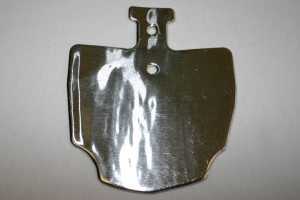
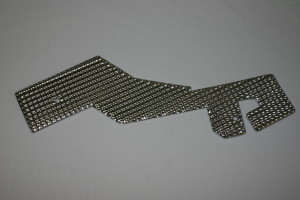
Careful planning allows the manufacturing engineers to optimize the number of identical shapes on the plate to allow for the maximum quantity of usable pieces. The process allows for the fast generation of uniform products to be used in mass production capacities. Almost any shape and size may be die-cut from a material. Options range from individual loose pieces cut from a sheet or roll or “kiss cut”, the process where the cut piece is left attached to a roll of release paper or other material.
The list of potential materials is long but some common ones are:
- Rubber
- Foam
- Fiber
- Foil
- Cloth
- Paper
- Plastic
- Pressure-sensitive adhesive tapes
- Heat-activated adhesive tapes
By varying the blade length or adjusting the bed-height, a single die may be employed to cut either single or multiple layers of laminated or stacked materials. Die-cutting to achieve consistent, uniform results is widely used to create parts which can be assembled into a finished, custom part or product.
Set up fees for creating dies can be expensive. The die is designed for maximum efficiency with minimal waste. The work involved is meticulous and exacting but a well-made die has a long life span and has the potential to create millions of tight tolerance precision parts.
The alternative to die-cutting is cutting each shape by hand, a painstaking and time consuming process which results in inconsistent product. Since manufacturers typically require large quantities, to keep up with supply and demand, automation using specialized machinery is always the better option in producing custom parts.
Can-Do National Tape offers both flatbed and rotary die-cutting services for a variety of adhesive and non-adhesive materials.
Kiss Cutting
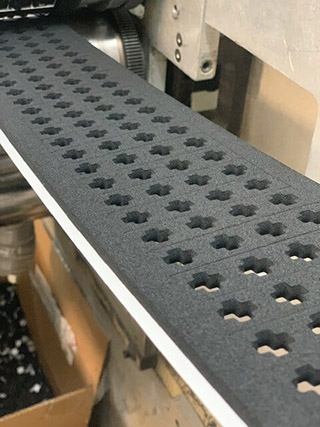 Can-Do offers customers the ability to kiss cut adhesive parts to a liner. Kiss cutting involves cutting through the base material down to, but not through, the liner/backing. During the kiss-cutting process, the perimeter of each part is cut by a sharp metal die or by a precision laser beam. This allows adhesive back parts to be removed from the backing liners more easily. Kiss cutting is one of the most popular methods for providing an easy-to-use converted adhesive tape solution.
Can-Do National Tape has multiple rotary and steel rule die-cutting presses, allowing us to provide our customers with a host of options. We utilize high speed, tight tolerance rotary tooling, up to 18″ wide for smaller/thinner materials; and for thicker, more rigid materials we employ flatbed steel rule dies for sheets up to 60′ x 54″.
Flat-Bed (Steel-Rule) Die-Cutting
There are a few types of die-cutting processes, but the most popular is Flatbed Die Cutting. For this process, the desired shape is formed from steel blades, optimized for maximum part production, and mounted onto the die plate. The die is mounted on the machine and then pressed into the material using a hydraulic press.
Can-Do operates several flatbed die cutting presses from 30Tons to 350Tons. Steel rule die cutting is used for shorter run quantities and thicker materials. Flatbed presses use less expensive steel-rule dies. Steel rule blades are bent and formed to the shape to be cut. These steel blades are held in place with a plywood board or steel braces. Steel rule dies are ideal for shorter runs where the cost of a rotary tool is prohibitive. Can-Do is also capable of using male /female die sets or hard tooling when it comes to cutting dense, hard-to-cut materials. Hard tooling is usually more expensive than a traditional steel rule or rotary die, but lasts much longer and holds a tighter tolerance. It is not uncommon to get one million or more impressions from a Male/Female die set.
Rotary Die-Cutting
Rotary Die Cutting uses a cylindrical die on a rotary press. Rolls of material are unwound and fed through a hydraulic press. As the cylindrical die rotates, it can cut out shapes, make perforations or creases, or even cut the material into smaller parts. Dies used in rotary die cutting are either solid engraved dies or some form of adjustable die. Engraved dies have a much higher tolerance and are machined out of a solid steel bar. Adjustable dies have removable blades that can be easily replaced with new blades, in the case of wear, or if the die is to be used to cut a different material. This conversion process is often performed in line with printing on the tape. A more sophisticated way of die-cutting is to cut through just one layer of material, stopping at a laminated layer or release paper substrate. This process is commonly known as “kiss-cutting”.
Success Story 1: Die-Cutting Application
An appliance manufacturer required a sound dampening material that would come into contact with other moveable components on the appliance that was being designed. Our sales person worked with the company’s engineers to design a part that would meet these technical specifications. The sales person identified a low density, closed cell foam and a high quality acrylic adhesive to laminate to the foam. Working with Can-Do’s converting manager, the customer and sales person designed a process to die cut the foam, laminate an adhesive product with a low co-efficient of friction surface, and re-register the product to be die cut again on a second pass. The pieces perform the required function, and Can-Do has been able to reduce cost to the customer by improving production processes and identifying less expensive materials.
~ Reduced Costs for Appliance Manufacturer
Success Story 2: Die-Cutting Application
Can-Do Tape’s customer had a problem with their process of making molded parts out of styrofoam impressions in molten metal. The customer was searching for a product to bond to a casting that could withstand high temperatures and not lose adhesion when exposed to liquids. We recommended a styrene material laminated with a high temperature acrylic adhesive. The foam was laminated and slit to width; and then, the material was die cut to the appropriate shape and put-up in roll form for ease of application. The problem was solved.
Converting Your Ideas into Reality.
<< Tape Converting Services >> << KISS-Cutting Services >>