Terms describing adhesive tape to help you with purchasing and product development.
Adhesive Tape – An adhesive invention which let to a material coated with a sticky adhesive to hold two surfaces together.
Adhesion – Adhesion is what develops between two dissimilar bodies when they are in contact. At the molecular level, adhesion is based on physical and some chemical bonding. The strength of adhesion depends on the type of adhesive.
Aging Resistance – Under certain conditions, a degree of reliable performance of the tape occurs over time.
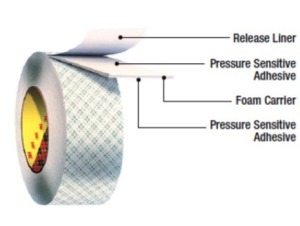
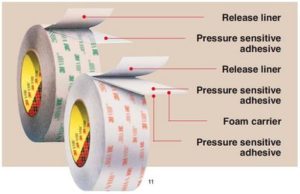
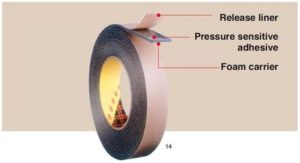
Backing (or Carrier) Material – The backing material carries the adhesive, reinforces PSA tape, and improves handling and processing properties. The most common types are:
- Film backings (e.g. PET, PP, PVC, PE)
- Paper-based backings (e.g. non-woven, tissue)
- Foam backings (e.g. PU-, PE- PVC-foams)
Cohesion – The inner strength of the adhesive that determines the holding power of the tape.
Conformability – When the backing of the tape influences its effect to adhere to a surface that is rough, curved or irregular.
Edge picking – An unwanted effect of the unwinding behavior of a roll of tape. This is caused by oozing of soft adhesives.
Fish eyes – When air is trapped between the roll’s layers, an optical effect is created.
Flame treatment – A method for modifying the surface of a substrate with a flame to provide a better bond for adhesive to a non-polar backing.
Hand tearable – Property of tapes which allows manual tearing or cutting without the use of a knife, scissors or dispenser. Both liner and backing must be tearable.
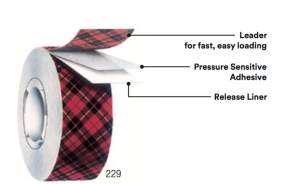
Liner – A material that is anti-adhesive and covers the adhesive on a double sided tape. The liner prevents the adhesive from sticking to itself. The liner is used as a protection aid during handling/processing and storage. Commonly used liners are:
- Paper liners (e.g. Glassine paper, PE-coated paper, Clay-coated paper)
- Film liners (e.g. PP, PET, PE) Usually, silicone is used as a release system to avoid adhesion between liner material and adhesive.
Migration – A molecular movement takes place when surfaces are in contact over a long period of time. Migration may occur between tape components and the surface to which it is applied. Some plastic films, like PVC, contain plasticizers, which are appropriate to migrate into the tape adhesive, allowing the adhesive to soften.
Oozing – When a softening adhesive is “squeezing out” at the edge of the tape.
Outgassing – The evaporating of chemical ingredients found in the adhesive (e. g. monomer residues, solvents, etc.) especially under elevated temperature conditions.
Peel Adhesion – The force needed to remove a pressure sensitive adhesive-coated material from it’s applied surface.
Plasticizer Resistance – The ability of a pressure sensitive tape to maintain it’s form under the influence of a plasticizer. When in contact with a plasticizer, the adhesive performance of a tape can be affected, especially with rubber-based adhesives.
Primer – A coating, like a backing or a substrate, which is applied to a surface prior to the application of an adhesive. This improves the bond performance between the tape and the substrate or between the backing and the adhesive.
PSA – Stands for Pressure Sensitive Adhesive Tape.
Release Force – The amount of force needed to remove a liner from the covered adhesive layer of double-sided tape. Release agents, like silicone, can change the release force.
Shear Resistance –
The amount of force required to pull the adhesive material parallel to the surface to which it was affixed under specific conditions. The shear resistance of pressure-sensitive tape may be measured statically or dynamically. Static shear test methods use a constant load of longer test times. Dynamic shear tests measure the cohesion of the sample in a tensile tester under increasing force or load.
Surface Energy – a term used to describe the surface of a given substrate. The molecular force of attraction between unlike materials determines their adhesion. The strength of attraction depends on the surface energy of the substrate. High surface energy means a strong molecular attraction, while low surface energy means weaker attractive forces.
Substrate – The material the tape is applied to.
Tack – Also known as “wet grab” or “quick stick”. It is the contact behavior of the adhesive to the substrate under a minimum of time and pressure.
Tensile Strength – The force required to break the adhesive material and/or the adhesive foam.
Our Can-Do Tape Consultants hope you find this Adhesive Tape Glossary helpful. If you have any questions, please feel free to call us at 1-800-643-5996
We Convert Your Ideas into Reality.
<< Tape History >> << PSA Tape >>